



Project management approaches were never well-suited for large-scale software implementation projects within organizations. Take ERP transformations, which will nearly always take 18 months, 24 months, 3 years - or forever. From a rational, time-oriented perspective, it is clear that such approaches are deeply flawed. The problem starts when executives and project managers assume that capacity is “structurally limited” and that there is a natural trade-off between scope/quality, cost and time.
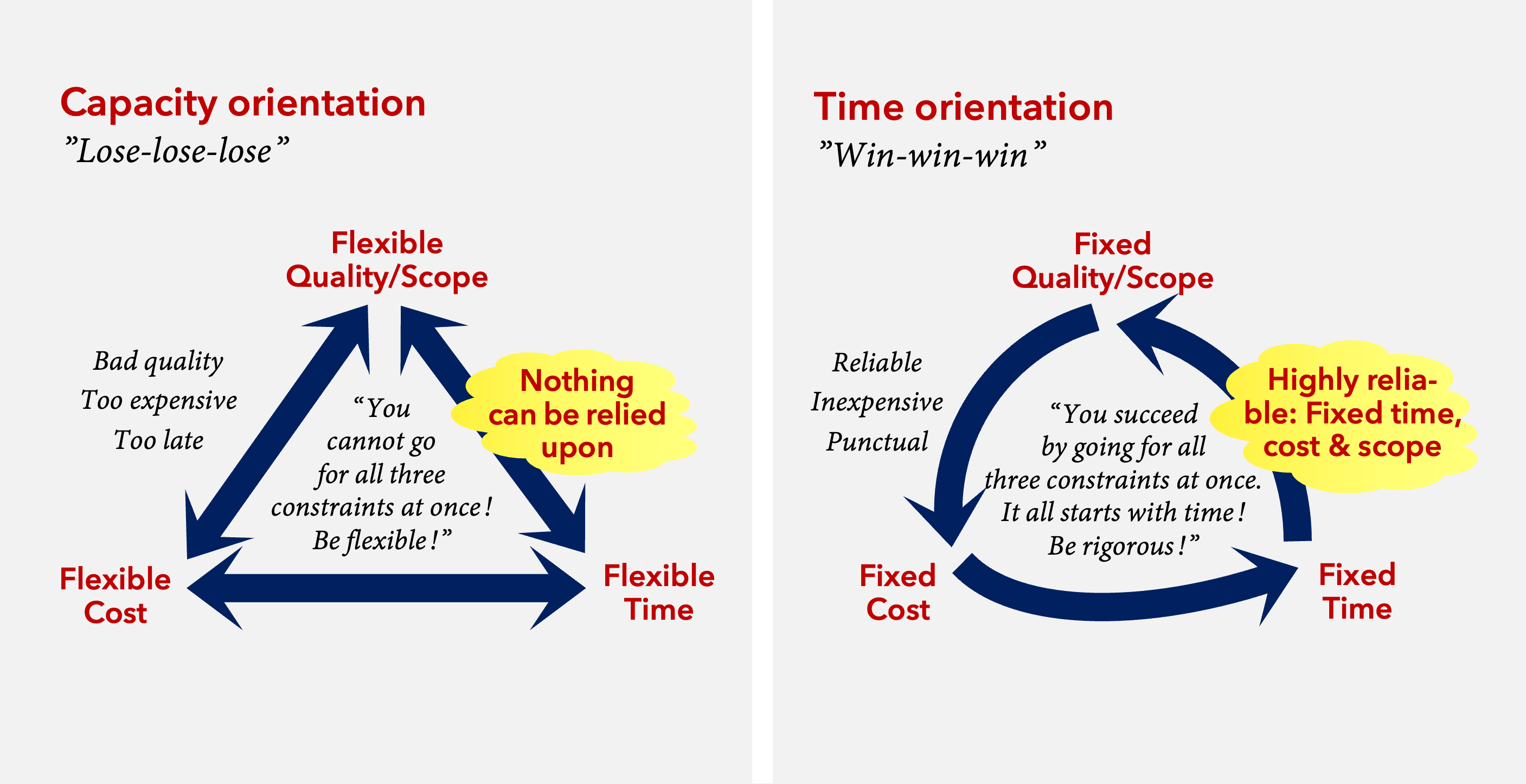
Behind this way of project thinking lies a concept called the Iron Triangle, or Triple Constraint Theory. But no matter how you call this mental model: It is profoundly flawed. It is, we believe, the key reason why so many software implementations drag on forever, why they fail, break or disappoint.
One of the things we figured out in late 2025, wile discussing time orientation in software development, is that software implementation projects are suffering from a lack of time orientation, just as software development does. Summing up our insight:
Large-scale corporate implementation projects (of ERPs and the like) should never take 18 or 24 months or more. They should take 90 days and be strictly time-oriented.
Put differently: The Iron Triangle is a hoax, conventional thinking has been misled by flawed assumptions around time, cost and quality – and their interdependence. In conventional thinking the relationship between the three “constraints” or corners of the triangle is a zero-sum game: There must be trade-offs. And never can all three corners of the triangle be pursued at the same time. In time-oriented thinking, by contrast ,we assume a positive relationship between time, quality/scope and cost. This positive circle of influence can only start with time, however, as time is the one and only true constraint in organizing project work. Cost and quality are consequences, or outcomes - not constraints, limitations or input factors.
To say that any corporate implementation project can be concluded in 3 months may sound crazy or incredible at first, but there is substance to it. We call that approach Time-Oriented Software Implementation or TOSI, for short. So how does TOSI work, and why should all organizations embrace this new approach, when dealing with large-scale implementation projects? Put in one sentence, the essence of TOSI is this:
Put time first – low cost & high quality will follow.
Roots and concepts of Time-Oriented Software Implementation, TOSI
Time orientation has a long history. One might say that modern time orientation on an industrial scale first manifested at Ford Motor Company in the 1920s, and then was further systematized at Toyota, between the 1950s and 1970s. In the contemporary sense, as pioneered by Austrian thinker-practitioner Ernst Weichselbaum, time orientation means fixing the total duration of delivery, and letting capacity swing according to demand, as opposed to considering capacity as “fix” and letting delivery time fluctuate. This requires a bit of elaboration.
While we traditionally assume that the capacity needed to undertake project work (e.g. in ERP adoptions) is scarce, or limited, in the TOSI approach we treat capacity as a system to be designed. Capacity is not considered a constraint, but the result of our design work that’s supposed to make the project happen within the given time frame of 90 days. Once appropriate capacity is assured for the 90 days (mainly in the shape of people’s mastery), then waiting, delays, lack of agreement, and other wastes can be eliminated from the work, and driving out of the project.
Here are some of the key concepts of TOSI:
Full availability during the 90 days allows for condensed timing. Make all necessary people available during the full duration of the 90 days. This alone will greatly accelerate the work and potentially help you accomplish more than you would otherwise accomplish in, say, 18 months. Develop an uncompromising attitude towards the necessary mastery, which might be internal or external, and from different external parties. Assuring the necessary mastery for three months is never “expensive”, when compared to stop-and-go, waiting, delays, lack of agreement, misunderstandings due to lack of availability, and re-work.
Eliminate committees and weekly, bi-weekly or monthly meeting cycles. Conversation around problems needs to happen according to the TTEO (Talk To Each Other) principle: On the spot, immediately, as needed, without intermediaries. TTEO will greatly accelerate updates, transparency and swift action. The TTEO principle is borrowed from the TOSD approach.
Time-box the main 90-day phase with two OpenSpace DEV events: Involve all relevant actors (which may be hundreds or thousands of individuals), right at the start. By having the Sponsor invite everyone to the OpenSpace 1 event and Prep Day, everyone will get a clear picture of the project at the start of the 90 days. OS1 also serves to analyze problems, list challenges, structure work streams and agree on solutions. This architecture in time is borrowed from the OpenSpace Beta approach created by Silke Hermann and Niels Pflaeging | Red42, which we have successfully applied many times, since 2018.
Organize the project’s software development side using the TOSD approach. TOSD allows daily rhythm in work and delivery to emerge. It is incredibly disciplined, incredibly transparent and effective.
This list of TOSI concepts is by no means meant to be exhaustive. We will report with further further on these and other TOSI concepts in an upcoming BetaCodex Network research paper.
Large-scale software implementations are socio-technical system transformations. Today, they are usually not handled accordingly. More often than not, the technical part of the transformation is handled technocratically, while the social part of the transformation is largely ignored or inappropriately handled. In effect, the socio-technical process derails, fails or grinds to a halt, at some point during the project. A time-oriented approach eliminates most of these symptoms we have all heard of and experienced. Time orientation with a 90-day baseline greatly reduces or entirely eliminates many annoyances of long-duration projects, such as stop-and-go project work, bad coordination, fizzling-out, or project team turnover.
Now that TOSI exists, every organization has the chance to opt for either extended misery and delays in large corporate projects (accompanied by massive risk of cost overruns and scope creep), or for highly concentrated, swift execution.
While previously, no other options existed, now, the choice is up to you.
About TOSI
TOSI is the 6th social technology originating from the BetaCodex Network and Red42, since 2018. The previous social technologies we created are OpenSpace Beta, Cell Structure Design, Relative Targets, OpenSpace DEV and Time-Oriented Software Development (TOSD).
Further reading
Read the TOSI research project announcement on the BetaCodex Network website
Read an article on Ernst Weichselbaum - the founder of contemporary time oriented organizing. We also recommend the bookWhat would Ernst Weichselbaum do?, edited by Niels Pflaeging | Red42 and published by BetaCodex Press
Find a more detailed outlining of the Iron Triangle conundrum and the primacy of time orientation in this article:
